

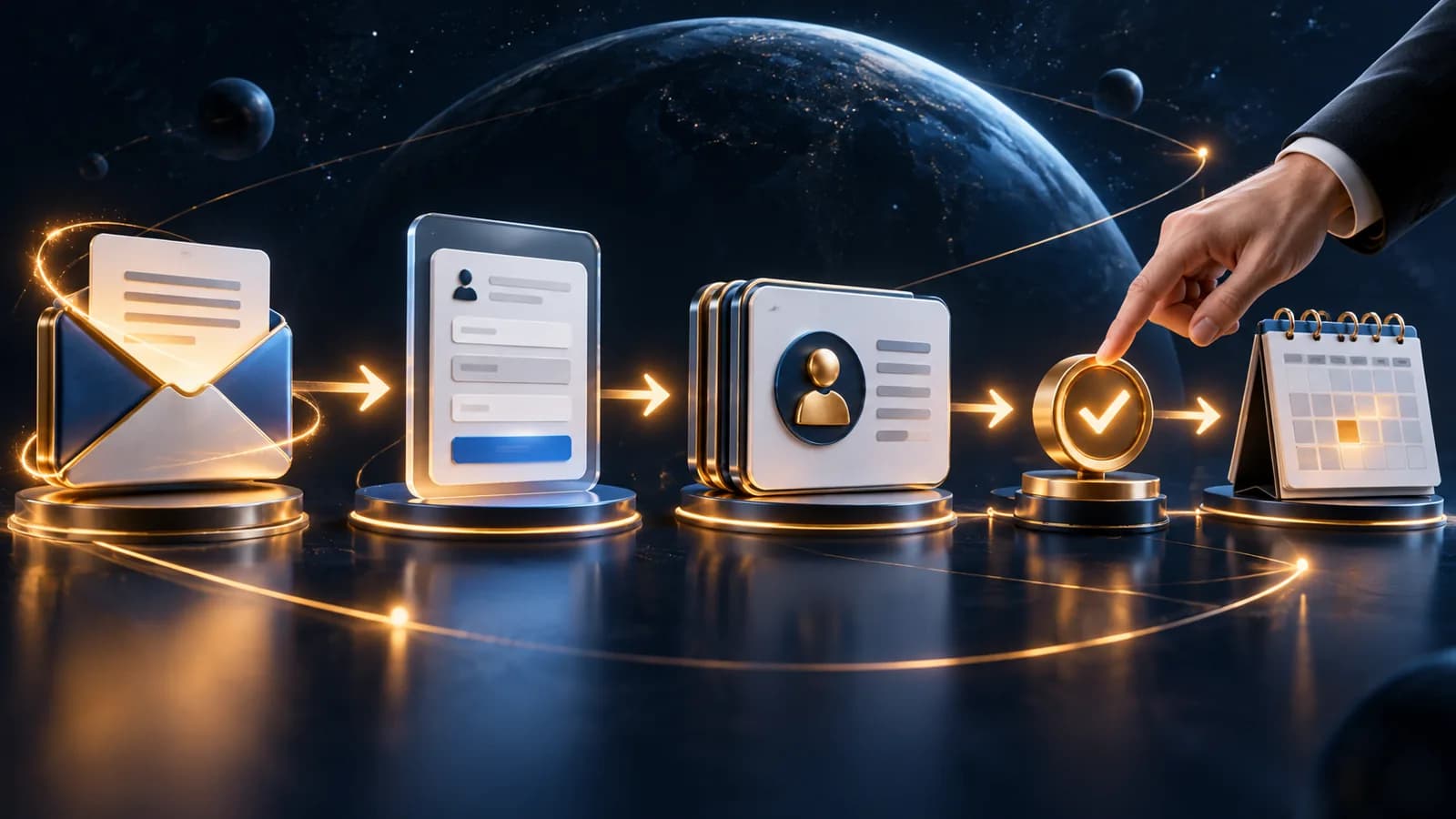
Marketing automation is the use of software that handles recurring marketing tasks automatically, such as emails that adapt to what your visitors do. Instead of someone planning by hand when each message goes out, everything runs on set rules: an email is triggered the moment a visitor lands on your site, submits an enquiry, or adds a product to their basket.
In this article we explain in plain language what marketing automation means, how it works, what you can do with it in practice, and what to keep in mind for GDPR compliance.
How does marketing automation work?
Think of an alarm clock: you set it, and it rings on time without you having to remember. Marketing automation works the same way: the software watches what a person does and reacts automatically.
Every setup has two building blocks:
- A trigger: the event that starts the automation, a visitor fills in a form, downloads a PDF or makes a purchase.
- An action: what happens next: an email is sent, a task goes to your team, the contact is added to a group.
The software links triggers and actions into a workflow. Each step runs on fixed rules, without anyone having to intervene.
What is lead nurturing?
A lead is a potential customer, someone interested in your offer who has not yet bought. Lead nurturing means keeping that person informed with relevant content over a longer period, until they are ready to make a decision.
In practice, that runs in three phases:
- Phase 1, make contact: the visitor signs up or submits an enquiry and receives a welcome email.
- Phase 2, build trust: over the following weeks they receive useful content: case studies, explanations, answers to common questions.
- Phase 3, move to the next step: an email with a concrete offer or a suggested call.
The goal: the person gets to know you before they decide and feels informed rather than sold to.
What does it look like in everyday business?
Here are three examples that make sense for small and mid-sized businesses:
- Welcome series: a visitor signs up for your newsletter and automatically receives three emails: a welcome message, an overview of your services, and a concrete offer.
- Abandoned enquiry follow-up: someone starts your enquiry form but never sends it. If the contact is already known and has consented, they receive an automatic reminder the next day, so the enquiry does not slip away.
- Segments and personalised content: your contacts are grouped, for example by industry or interest. Each group receives content that fits it: a trades business sees different examples from a law firm.
| Example | Trigger | Action |
|---|---|---|
| Welcome series | Newsletter sign-up | Three-email sequence over time |
| Abandoned enquiry follow-up | Form started, never submitted | Reminder after one day |
| Personalised content | Contact added to a segment | Different content per group |
What tools are available?
Providers range from focused email tools to platforms that combine email, landing pages and CRM in one place. For small and mid-sized businesses, tools that are easy to use with transparent pricing are the right choice.
What to look for:
- GDPR compliance: servers in Germany or the EU, and a data processing agreement in place.
- Easy integration: the tool connects with your website, CRM or accounting software.
- Transparent pricing: you know what the software costs and what it does not.
- Room to grow: the software scales as your contact list grows.
What about GDPR?
GDPR requires you to be able to prove that each recipient consented:
- Active consent: the person ticked the box themselves: it was not pre-ticked.
- Clear content: they know what they subscribed to and who is behind it.
- Easy unsubscribe: every email includes an unsubscribe link.
- Proof: the date, the exact wording and the IP address of the click are stored.
Conclusion: marketing automation saves time and makes your emails more personal
Marketing automation is not high tech but good organisation: who does what, when does it happen, and what comes next? Once you have answered those questions clearly, the software can take over the routine.
The first automations, a welcome series, a follow-up for abandoned enquiries, are quick to set up and save time immediately. If you are not sure where to start, talk to us: we will look at your existing processes and show you which automation genuinely pays off for your business.