
An ERP system is business software that links orders, purchasing, stock, accounting and other areas on one shared set of data. ERP stands for enterprise resource planning. The basic idea is that every piece of information is entered once and then available everywhere. Whether that pays off for a small company depends on your processes.
What exactly is an ERP system?
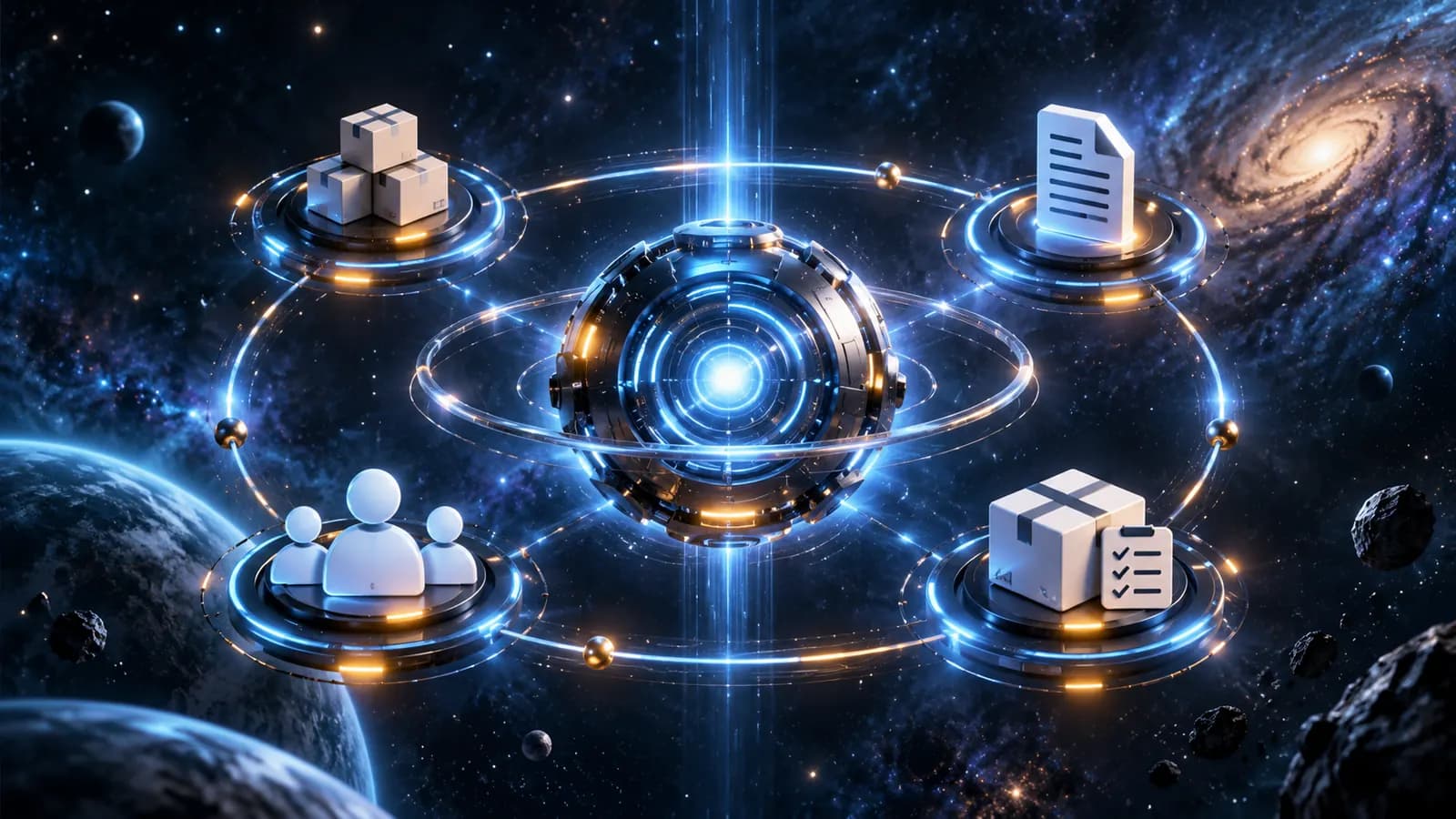
Imagine a customer places an order. Sales creates the order, the warehouse reserves the goods, purchasing reorders missing material and accounting writes the invoice. In an ERP system these steps access the same data: the same customer number, the same article number, the same stock level. If something changes, every department sees it at once.
Without ERP, each department often works with its own lists. Data then has to be entered several times and figures drift apart. An ERP system is meant to remove exactly that double work and those contradictions.
Which modules does an ERP system have?
ERP systems are built from modules that you use as needed. The table shows common building blocks.
| Module | Task | Important if … |
|---|---|---|
| Sales and orders | Quotes, orders, delivery notes | You process many orders |
| Purchasing | Orders, suppliers, goods received | You buy material or goods for resale |
| Stock | Levels, locations, batches, serial numbers | You hold goods in stock |
| Production | Bills of materials, production orders, capacity | You manufacture products |
| Finance | Invoices, payments, accounting export | You need up-to-date figures |
| People and projects | Time, assignments, project costs | You bill services by effort |
Most small businesses need only two or three modules. When exporting to your tax adviser, look for a common format, such as an export in DATEV format.
Who needs an ERP system?
An ERP system pays off most when you store goods, make something or have many material movements, as in retail, manufacturing or wholesale. Several sites, batches or serial numbers also speak for it. Errors then arise mainly because stock, orders and invoices do not match.
A service business with few employees usually does not need one. Customer management, quotes and invoices can be covered with a CRM and invoicing software. The difference between the two systems is explained in CRM vs ERP: the difference.
How do you know it is too early or too late?
It is too early if your processes are not yet clear, if everyone works differently or if a spreadsheet works well. Software maps processes; it does not create them. First clarify how an order runs from enquiry to payment.
It is too late if you regularly enter data in several lists, stock levels are wrong, month-end closing takes days or nobody knows which jobs make a profit. A system then pays off because the price of doing nothing is already visible.
How do you proceed step by step?
Begin with the area where it hurts most, such as stock levels or invoices. Describe the process on one page, choose a suitable tool and introduce one module first. Connect further systems later through interfaces instead of replacing everything at once. Whether standard software or a custom solution fits better is covered in Off-the-shelf vs custom software.
- Process from order to payment described on one page
- Places noted where data is entered twice
- Necessary modules named, not all available ones
- Data protection, location and data export checked
- Export for the tax adviser clarified
- Started with one module and learned from it
Conclusion: clarify the process first, then choose software
An ERP system is a powerful tool, but not the right first step for every small company. Clarify your process, start with one module and extend as needed. If you want to know what makes sense in your case, see our business systems service or describe your process.